MyMoney.my.id
  • Home
  • Ask and Answer
  • Psychological
  • Export import
  • About Us
    • Contact
    • Privacy Policy
Search
  • Contact
  • Blog
  • Complaint
  • Advertise
© 2023 MyMoney.my.id. All Rights Reserved.
Reading: Force Majeure: The Concept and Its Impact on Contracts
Share
Sign In
Notification Show More
Latest News
How will the Layaway plan benefit retailers and customers?
Ask and Answer
Forbes’ 5 Best Crypto Exchanges
Psychological
Employee Stock Option Program (ESOP)
Ask and Answer
The Definition and Process of the Accounting Cycle: Understanding the Phases and Their Benefits for the Company
Ask and Answer
Dividend Reinvestment Plan (DRIP): Compound interest program on stock investment
Ask and Answer
Aa
MyMoney.my.id
Aa
  • Home
  • Ask and Answer
  • Psychological
  • Export import
  • About Us
Search
  • Home
  • Ask and Answer
  • Psychological
  • Export import
  • About Us
    • Contact
    • Privacy Policy
Have an existing account? Sign In
Follow US
  • Contact
  • Blog
  • Complaint
  • Advertise
© 2022 Foxiz News Network. Ruby Design Company. All Rights Reserved.
MyMoney.my.id > Blog > Ask and Answer > Force Majeure: The Concept and Its Impact on Contracts
Ask and Answer

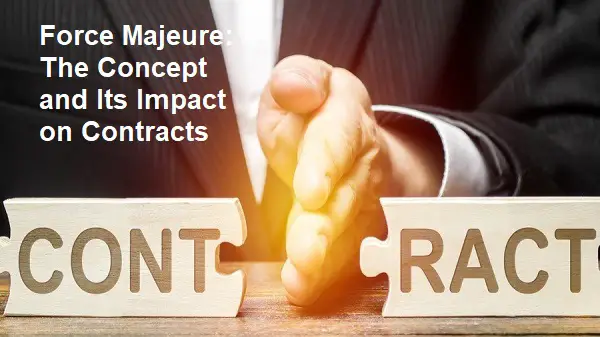
Force Majeure: The Concept and Its Impact on Contracts

admin
Last updated: 2024/01/22 at 12:54 AM
admin
Share
SHARE

Force majeure is a term used to describe events that occur beyond human control and cannot be avoided. Decisions taken or actions taken by a person cannot influence or control these events. Examples of force majeure events include natural disasters, wars, fires, accidents or system failures.

In a legal context, force majeure is often considered in a contract as a basis for releasing one of the parties from the obligation to fulfill the obligations stated in the contract. This can happen if a force majeure event makes the party concerned unable to fulfill the obligations stated in the contract.

In this article, we will discuss in more detail what force majeure is, the concepts governing force majeure in law, and examples of force majeure events that often occur. In addition, we will also discuss how force majeure can affect the fulfillment of contractual obligations and how the parties to the contract can handle force majeure events.

Definition and Concept of Force Majeure

Force majeure is a term that comes from the French which means “greater force”. In the legal context, force majeure is considered as an event that occurs beyond human control and cannot be avoided. Such force majeure events may affect the fulfillment of the obligations stated in the contract.

The principles governing force majeure in law consist of three things, namely:

– Force majeure events must occur beyond human control and cannot be avoided.
– Force majeure events must affect the fulfillment of the obligations stated in the contract.
– The party concerned must show that the force majeure event did occur and affect the fulfillment of obligations.

In contracts, force majeure is often regulated in a section called the force majeure clause. This clause explains what is considered a force majeure event, how force majeure events will be considered in the contract, and how the parties to the contract can handle force majeure events. If a force majeure event occurs, the party concerned must notify the other party immediately so they can find an appropriate solution.

Examples of Force Majeure Events

Force majeure events often occur throughout the world and can affect the fulfillment of contractual obligations. Some examples of force majeure events that often occur are:

1 Natural disasters, such as earthquakes, tsunamis, floods and droughts.
2 War or armed conflict.
3 Fire or accident causing damage to facilities or equipment.
4 System failure, such as failure of the power grid or telecommunication system.

These events can affect the fulfillment of obligations in the contract, especially if the incident occurs in a location where the party concerned must perform an obligation. For example, if an earthquake occurs which causes damage to the facilities used to carry out obligations, then the parties concerned cannot fulfill their obligations according to the agreed schedule.

In addition, force majeure events can also affect the fulfillment of obligations in the contract in the event of war or armed conflict at the location where the party concerned must carry out obligations. System failures, such as power grid or telecommunications system failures, can also affect the fulfillment of contractual obligations if the system is used to perform the obligations.

Impact of Force Majeure on the Contract

Force majeure can affect the fulfillment of obligations in the contract by preventing or making the party concerned unable to fulfill the obligations stated in the contract. If a force majeure event occurs, the party concerned must notify the other party immediately and show that the force majeure event did occur and affects the fulfillment of obligations.

The parties to the contract can handle force majeure events by:

* Change the schedule for fulfilling obligations according to existing conditions.
* Looking for alternative solutions to fulfill the obligations stated in the contract.
* Cancel or terminate the contract.

The law treats force majeure by freeing the party concerned from the obligation to fulfill the obligations stated in the contract. However, the party concerned must show that a force majeure event did occur and affected the fulfillment of obligations.

The Importance of Contract Clauses When a Force Majeure Occurs

One way to deal with force majeure in a contract is to include a clause force majeure in the contract. This clause will regulate how force majeure events will be faced by both parties. A force majeure clause will usually include information about what is considered a force majeure event, how the force majeure event will be dealt with, and how the contract will be continued after the force majeure event.

With the existence of a contract clause that regulates force majeure, both parties can be better prepared to deal with force majeure events that may occur. In addition, the right contract clauses can also help maintain a good relationship between the two parties. Without a contractual clause that regulates force majeure, both parties may feel uncertain and confused about the force majeure event that occurs.

Therefore, it is important for both parties to include contractual clauses regarding force majeure in a contract so that they can be better prepared for force majeure events that may occur. Thus, both parties can avoid problems that may occur during the implementation of the contract.


You Might Also Like

How will the Layaway plan benefit retailers and customers?

Employee Stock Option Program (ESOP)

The Definition and Process of the Accounting Cycle: Understanding the Phases and Their Benefits for the Company

Dividend Reinvestment Plan (DRIP): Compound interest program on stock investment

Lock Up: Definition and Benefits for Companies

Sign Up For Daily Newsletter

Be keep up! Get the latest breaking news delivered straight to your inbox.
By signing up, you agree to our Terms of Use and acknowledge the data practices in our Privacy Policy. You may unsubscribe at any time.
admin
Share this Article
Facebook Twitter Copy Link Print
Previous Article Get to know the General Ledger: How it Works and Benefits in Managing Company Finances
Next Article Cash Flow and Interest, What’s the Difference?
Leave a comment

Leave a Reply Cancel reply

Your email address will not be published. Required fields are marked *

Stay Connected

248.1k Like
69.1k Follow
134k Pin
54.3k Follow

Latest News

  • What is a Multi Account Manager (MAM)?

    What is a Multi Account Manager (MAM)?

  • Yield to Call (YTC): Definition, Formulas and How to Calculate It

    Yield to Call (YTC): Definition, Formulas and How to Calculate It

  • What is meant by Economic Recovery?

    What is meant by Economic Recovery?

  • Lock Up: Definition and Benefits for Companies

    Lock Up: Definition and Benefits for Companies

  • Hustler, Hacker and Hipster in the Startup World

    Hustler, Hacker and Hipster in the Startup World

Recent Posts

  • The Definition and Process of the Accounting Cycle: Understanding the Phases and Their Benefits for the Company

    The Definition and Process of the Accounting Cycle: Understanding the Phases and Their Benefits for the Company

    The accounting cycle is a continuous process used by companies to follow the flow of money and financial information. This is very important because it helps companies understand their financial …
  • What is a Brownfield Investment? Advantages and Risks and How to Avoid Them

    What is a Brownfield Investment? Advantages and Risks and How to Avoid Them

    Brownfield investment is one type of investment that is often made by companies or investors. Brownfield investment is an investment made in a project or business that already exists and …
  • Getting to Know the Business Environment: What is it and How to Understand It?

    Getting to Know the Business Environment: What is it and How to Understand It?

    The business environment is an important aspect that needs to be considered by an entrepreneur or businessman in managing and developing his business. Because the business environment includes all external …
  • Asset Revaluation and its Benefits for the Company

    Asset Revaluation and its Benefits for the Company

    Fixed assets have a dynamic value or change over time. Some assets have a value that tends to decrease from their value when they were first acquired. But, some others …
  • Value at Risk (VAR): Definition, Methods, Applications and Weaknesses

    Value at Risk (VAR): Definition, Methods, Applications and Weaknesses

    Risk is an integral part of investments and other financial transactions. For this reason, for every investor or financial company, it is important to identify the risks of these activities …
  • Example of Marginal Rate of Substitution (MRS) Application

    Example of Marginal Rate of Substitution (MRS) Application

    The marginal rate of substitution (MRS) is one of the most important concepts in economics. MRS indicates the level of replacement between two goods that can be accepted by a …
  • The 5 Biggest Fintech in the World Based on Market Capitalization

    The 5 Biggest Fintech in the World Based on Market Capitalization

    Fintech or financial technology is a form of integration between technology and the financial system. The term fintech initially referred only to the use of technology, such as a computer …
  • Where Does Our Money Go When We Have Got Margin Call

    Where Does Our Money Go When We Have Got Margin Call

    What are Margin Calls? Margin Call is a warning that equity or capital is barely sufficient margin required to maintain open transactions. Therefore, a margin call is basically a warning …
  • Oligopsony: Resulting Implications and Possible Solutions

    Oligopsony: Resulting Implications and Possible Solutions

    Oligopsony is a situation where there are few buyers who control the selling price of a good or service. This condition can occur in various sectors, such as the manufacturing …
  • Lock Up: Definition and Benefits for Companies

    Lock Up: Definition and Benefits for Companies

    What is Lock Up? Lock up in shares means locking up shares belonging to certain investors so that they cannot sell their shares for a while. This policy is enforced …
  • Get to know what a solvency ratio is and its importance in assessing a company’s financial condition

    Get to know what a solvency ratio is and its importance in assessing a company’s financial condition

    The Solvency Ratio is one of the ratios used to assess a company’s financial health. This ratio is commonly used by investors before investing in a company, creditors before making …
  • OPEC: The Organization That Regulates Oil Production and Prices in Global Markets

    OPEC: The Organization That Regulates Oil Production and Prices in Global Markets

    In the 1960s, oil producing countries formed an organization called OPEC. They formed the organization as a form of dissatisfaction with the control of foreign oil companies over the resources …
  • Yield to Call (YTC): Definition, Formulas and How to Calculate It

    Yield to Call (YTC): Definition, Formulas and How to Calculate It

    Yield to Call is a metric used in calculating the profit potential of a convertible bond. You can use this method to compare the rate of return on a convertible …
  • Employee Stock Option Program (ESOP)

    Employee Stock Option Program (ESOP)

    Employee Stock Option Program – ESOP is a program from the company to employees by giving employees the right to buy shares of the company. This program allows employees to …
  • What are International Money Orders?

    What are International Money Orders?

    The International Money Order is one of the most popular ways to send money overseas. An International Money Order is a kind of check issued by a financial company or …

Most Viewed Posts

  • Days Sales Outstanding (DSO) (981,555)
  • Currency War, What Is It? (981,500)
  • Oligopsony: Resulting Implications and Possible Solutions (981,492)
  • Critical Mass in Business: Recognizing the Concept, Influencing Factors, and How to Achieve It (981,127)
  • Getting to Know the Contagion Effect and Efforts to Handle it in the Economic Sector (910,909)
Follow US

© 2025 MyMoney.my.id. All Rights Reserved.

Removed from reading list

Undo
Welcome Back!

Sign in to your account

Lost your password?
