MyMoney.my.id
  • Home
  • Ask and Answer
  • Psychological
  • Export import
  • About Us
    • Contact
    • Privacy Policy
Search
  • Contact
  • Blog
  • Complaint
  • Advertise
© 2023 MyMoney.my.id. All Rights Reserved.
Reading: 10 Largest Stock Exchanges Based on Market Capitalization
Share
Sign In
Notification Show More
Latest News
How will the Layaway plan benefit retailers and customers?
Ask and Answer
Forbes’ 5 Best Crypto Exchanges
Psychological
Employee Stock Option Program (ESOP)
Ask and Answer
The Definition and Process of the Accounting Cycle: Understanding the Phases and Their Benefits for the Company
Ask and Answer
Dividend Reinvestment Plan (DRIP): Compound interest program on stock investment
Ask and Answer
Aa
MyMoney.my.id
Aa
  • Home
  • Ask and Answer
  • Psychological
  • Export import
  • About Us
Search
  • Home
  • Ask and Answer
  • Psychological
  • Export import
  • About Us
    • Contact
    • Privacy Policy
Have an existing account? Sign In
Follow US
  • Contact
  • Blog
  • Complaint
  • Advertise
© 2022 Foxiz News Network. Ruby Design Company. All Rights Reserved.
MyMoney.my.id > Blog > Ask and Answer > 10 Largest Stock Exchanges Based on Market Capitalization
Ask and Answer

10 Largest Stock Exchanges Based on Market Capitalization

admin
Last updated: 2024/01/22 at 12:53 AM
admin
Share
SHARE

The stock exchange is the center for trading stocks and other types of securities. The stock exchange is a place that brings together buyers and sellers of securities. As well as being a party that oversees and makes rules in securities trading operations.

In Indonesia itself, the party that has the authority to carry out securities trading is the Indonesia Stock Exchange (IDX). Meanwhile, in other countries, of course, they have their own stock exchanges with different names. For example, in Malaysia, stock traders are organized by Bursa Malaysia and in Singapore there is the Singapore Stock Exchange (Singapore Exchanges).

Of the three examples of stock exchanges, it turns out that none of them is included in the list of the top 10 stock exchanges in the world. The valuation method is based on the total market capitalization of listed issuers on each stock exchange. However, be it the IDX, Bursa Malaysia or Singapore Exchanges, the market capitalization value of listed companies is still quite low.

Then, which exchanges are ranked in the top 10 as the largest stock exchanges in the world? Here is the list!.

1. New York Stock Exchange (NYSE)

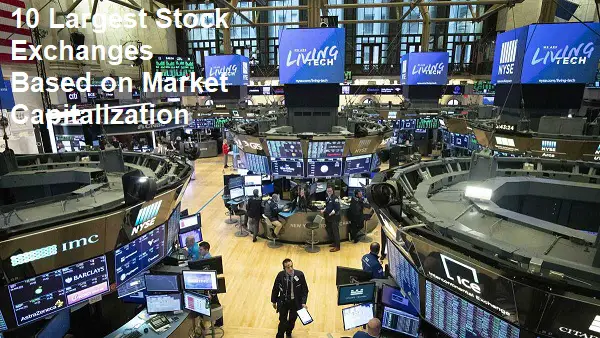
The New York Stock Exchanges (NYSE) is the oldest stock exchange in the US. Founded in 1817, the NYSE is located at 11 Wall Street, Manhattan, New York City. NYSE is also known as a traditional exchange which still uses a double auction system.

Initially, the NYSE operated as a private institution. However, since 2005, the NYSE has become a publicly traded company. The NYSE is managed by NYSE Euronext, which is the result of a merger between the NYSE and the European Stock Exchanges.

The NYSE is the world’s largest stock exchange by market capitalization. As of October 2022, the NYSE’s market capitalization has reached the US$22.11 trillion mark. Currently, there are 2,308 companies whose shares are traded on the NYSE.

2. National Association of Securities Dealers Automated Quotations (NASDAQ)

The National Association of Securities Dealers Automated Quotations, or better known as the NASDAQ, is one of the exchanges that also operates in the United States. Founded on February 8, 1971 in New York, United States of America, by the National Association of Securities Dealers Automated Quotations (NASDAQ).

Although both operate in the US, the NASDAQ is different from the NYSE. The NASDAQ was specifically created as a stock exchange for US electronics companies. To date, there are 3,554 companies listed on the NASDAQ, including large companies such as Alphabet, Apple, Amazon, Baidu, Microsoft and so on.

The NASDAQ is the second stock exchange with the largest market capitalization in the world. Data in October showed that the NASDAQ’s market cap had reached 17.23 trillion US dollars.

3. Shanghai Stock Exchange (SSE)

Shanghai Stock Exchanges, is the largest stock exchange in China. As the name suggests, this exchange is located in Shanghai City, the largest city in China. The Shanghai Stock Exchanges was founded on November 26, 1990, but only started operations on December 19, 1990.

The Shanghai Stock Exchanges is a non-profit organization, namely a non-profit organization, which is managed by the China Securities Regulatory Commission (CSRC). Just like stock exchanges in general, the Shanghai Stock Exchange also has several stock indices. The main index is the SSE Composite which reflects the average performance of the stocks listed on the exchange. While other important indexes are the SSE 50 Index and the SSE 180 Index.

The Shanghai Stock Exchanges (SSE) is the third largest stock exchange in the world and the first in Asia by market capitalization. SSE as of October 2022 has reached a market capitalization of 5.98 trillion US dollars.

4. European Stock Exchanges (Euronext)

European Stock Exchanges or Euronext for short is a European stock exchange located in Paris, France. This stock exchange was founded in 1724, originally called the Paris Bourse. The name Euronext was used since the exchange was merged with other existing exchanges in Amsterdam, Lisbon and Brussels in 2000.

Currently, there are 1,078 listed companies whose shares are traded on the European Stock Exchanges (Euronext). Euronext itself is headquartered in Paris, France, but oversees several companies spread across Belgium, the Netherlands, Portugal and England.

Euronext is the world’s fourth largest stock exchange based on market capitalization. As of November 2022, Euronext’s market capitalization is USD 5.52 trillion.

5.Japan Exchange Group (JPX)

The Japan Exchange Group is a holding company for financial instrument exchanges. This company is the result of a merger between Tokyo Stock Exchanges, Inc and Osaka Exchange Co., Ltd in 2013. The Japan Exchange Group oversees 3 stock exchanges in Japan, namely: Tokyo Stock Exchanges (stock exchange), Osaka Exchange (Derivatives Exchange) and Tokyo Commodity Exchange (futures exchange). In addition, JPX also has several other subsidiaries, such as JPX Market Innovation & Research, Inc., Japan Exchange Regulation (JPX-R) and Japan Securities Clearing Corporation (JSSC).

JPX is the 5th largest exchange in the world with a market capitalization value of US$4.91 trillion in October 2022. And is the 2nd largest in Asia, after the Shanghai Stock Exchanges.

6. Shenzhen Stock Exchanges (SZSE)

Shenzen Stock Exchanges is one of the stock exchanges in China besides the Shanghai Stock Exchanges. The exchange was founded on December 1, 1990 and operates independently. Just like most stock exchanges, the Shenzhen Stock Exchange also functions as a party that oversees and organizes securities trading and arranges operations in securities trading activities.

The Shenzhen Stock Exchanges has a market capitalization of US$4.23 trillion, as of October 2022 and places this exchange as the 6th largest in the world. This capitalization value has increased from 2021 which only reached US$3.90 trillion. At the same time pushing the ranking of the Shenzen Stock Exchanges from number 8, crawling up to number 6 in the list of the world’s largest stock exchanges based on market capitalization.

7. Hongkong Exchanges (HKEX)

​​​​​Hongkong Exchanges is a stock exchange based in Hong Kong. Established on March 6 2020 and is the parent of several financial exchanges in Hong Kong and London. Some of the companies under Hongkong Exchanges are The Stock Exchange of Hong Kong Limited, Hong Kong Futures Exchange Limited and Hong Kong Securities Clearing Company Limited.

Hongkong Exchanges has a market capitalization of US$3.36 trillion in October 2022. This makes this exchange the seventh largest stock exchange in the world. In addition, the Hong Kong Exchange is also the fourth largest exchange in Asia, under the Shenzhen Stock Exchanges.

8.National Stock Exchanges of India (NSE)

The National Stock Exchanges of India (NSE) is a stock exchange located in Mumbai, India. This exchange was established in 1992 and is owned by various domestic and international financial institutions, both public and private entities.

The National Stock Exchanges of India (NSE) has 2,002 listed issuers with a market capitalization of US$3.28 trillion. NSE was the largest derivatives exchange in 2021 based on trading volume, and is the 8th largest stock exchange in the world.

9. Saudi Stock Exchanges (Tadawul)

Saudi Stock Exchanges is a stock exchange operating in Saudi Arabia. This stock exchange is the largest in the Middle East. Formed in 2007 and designated as the only company authorized as a stock exchange in Saudi Arabia.

As of May 2021, the Saudi Stock Exchanges have listed shares from 203 issuers. It has a market capitalization of US$2.86 trillion in October 2022 and is the 9th largest stock exchange in the world, out of a total of 67 members registered with the World Federation of Exchanges.

10. London Stock Exchanges Group (LSE)

The London Stock Exchanges Group (LSE) is a stock exchange operating in London, England. The LSE was founded in 1801, and is one of the oldest stock exchanges still operating today. Originally, the LSE was on Threadneedle Street. However, in July 2004, the LSE moved to Paternoster Square, which is also still located in the London area.

LSE has a total market capitalization of US$2.82 trillion. This number makes the LSE one of the largest stock exchanges in the world, ranking 10th. In addition, the LSE also has a main index called the FTSE or Financial Time Stock Exchanges which is a general indicator to see the performance of the London stock market.


You Might Also Like

How will the Layaway plan benefit retailers and customers?

Employee Stock Option Program (ESOP)

The Definition and Process of the Accounting Cycle: Understanding the Phases and Their Benefits for the Company

Dividend Reinvestment Plan (DRIP): Compound interest program on stock investment

Lock Up: Definition and Benefits for Companies

Sign Up For Daily Newsletter

Be keep up! Get the latest breaking news delivered straight to your inbox.
By signing up, you agree to our Terms of Use and acknowledge the data practices in our Privacy Policy. You may unsubscribe at any time.
admin
Share this Article
Facebook Twitter Copy Link Print
Previous Article How to Calculate Abnormal Return
Next Article Effect of Consumer Confidence Index (CCI) on economic growth
Leave a comment

Leave a Reply Cancel reply

Your email address will not be published. Required fields are marked *

Stay Connected

248.1k Like
69.1k Follow
134k Pin
54.3k Follow

Latest News

  • Getting to Know Bank Reconciliation: Why Is It Important and How Is It Done?

    Getting to Know Bank Reconciliation: Why Is It Important and How Is It Done?

  • Hustler, Hacker and Hipster in the Startup World

    Hustler, Hacker and Hipster in the Startup World

  • How to Trade When High Impact News Happen

    How to Trade When High Impact News Happen

  • Reasons People Stay in the Forex Trading Business

    Reasons People Stay in the Forex Trading Business

  • Get to know what a solvency ratio is and its importance in assessing a company’s financial condition

    Get to know what a solvency ratio is and its importance in assessing a company’s financial condition

Recent Posts

  • How will the Layaway plan benefit retailers and customers?

    How will the Layaway plan benefit retailers and customers?

    What is Layaway? Layaway is basically defined as a shopping method, in which customers shop for certain products by making a small deposit and store the products for later collection. …
  • Employee Stock Option Program (ESOP)

    Employee Stock Option Program (ESOP)

    Employee Stock Option Program – ESOP is a program from the company to employees by giving employees the right to buy shares of the company. This program allows employees to …
  • Get to know the General Ledger: How it Works and Benefits in Managing Company Finances

    Get to know the General Ledger: How it Works and Benefits in Managing Company Finances

    General Ledger is an important part of the company’s financial system. Through General Ledger, companies can record and manage all financial transactions that occur, from receiving money to spending money. …
  • Sidechain: Definition, Functions, and Weaknesses

    Sidechain: Definition, Functions, and Weaknesses

    Blockchain is a digital database where cryptocurrencies are transacted. Blockchain has network nodes that act as validators while maintaining the security of the blockchain network from hacking. In a crypto …
  • OPEC: The Organization That Regulates Oil Production and Prices in Global Markets

    OPEC: The Organization That Regulates Oil Production and Prices in Global Markets

    In the 1960s, oil producing countries formed an organization called OPEC. They formed the organization as a form of dissatisfaction with the control of foreign oil companies over the resources …
  • The 5 Worst Crisis That Ever Happened to the World Economy

    The 5 Worst Crisis That Ever Happened to the World Economy

    2023 is predicted to be a dark year for the global economy. Many parties predict that the world economy will experience a recession and even be at risk of experiencing …
  • Insurance Franchise: Definition, Benefits, and Steps

    Insurance Franchise: Definition, Benefits, and Steps

    Insurance is a type of financial product that aims to protect a person’s or company’s finances from unexpected risks. However, did you know that now there is another way to …
  • Getting to Know Bank Reconciliation: Why Is It Important and How Is It Done?

    Getting to Know Bank Reconciliation: Why Is It Important and How Is It Done?

    Have you ever found an error in your company’s financial statements that you can’t explain? Or maybe you have doubts about the accuracy of the balance in your bank account? …
  • Where Does Our Money Go When We Have Got Margin Call

    Where Does Our Money Go When We Have Got Margin Call

    What are Margin Calls? Margin Call is a warning that equity or capital is barely sufficient margin required to maintain open transactions. Therefore, a margin call is basically a warning …
  • Brand Awareness: Definition, Benefits, How to Build, and The Indicators

    Brand Awareness: Definition, Benefits, How to Build, and The Indicators

    In running a business, making innovative products and having good quality is not enough. Business actors must also be able to market these products among consumers, compete with other products …
  • Market Anomalies: Definition, Causes and Examples

    Market Anomalies: Definition, Causes and Examples

    Market anomalies are understood as unusual conditions in financial markets. There are various causes, including geopolitical events, central bank intervention, changes in a country’s interest rates and so on. Knowing …
  • What are the benefits received by fan token owners?

    What are the benefits received by fan token owners?

    Fan tokens are products derived from cryptocurrencies launched by a sports club in collaboration with crypto companies to provide space for collectors to vote on a number of decisions. Imagine …
  • It used to be worth $ 0, this is how the price of Bitcoin changes from year to year

    It used to be worth $ 0, this is how the price of Bitcoin changes from year to year

    Bitcoin is a cryptocurrency asset that has the largest market capitalization in the world, as well as being the most expensive cryptocurrency at the moment. The amount of supply of …
  • Example of Marginal Rate of Substitution (MRS) Application

    Example of Marginal Rate of Substitution (MRS) Application

    The marginal rate of substitution (MRS) is one of the most important concepts in economics. MRS indicates the level of replacement between two goods that can be accepted by a …
  • Dividend Reinvestment Plan (DRIP): Compound interest program on stock investment

    Dividend Reinvestment Plan (DRIP): Compound interest program on stock investment

    Dividends are profits generated from investing in stocks. Dividends are part of the company’s profits distributed to investors. Dividend distribution is generally carried out in cash, but under certain conditions, …

Most Viewed Posts

  • Days Sales Outstanding (DSO) (981,562)
  • Currency War, What Is It? (981,508)
  • Oligopsony: Resulting Implications and Possible Solutions (981,498)
  • Critical Mass in Business: Recognizing the Concept, Influencing Factors, and How to Achieve It (981,145)
  • Getting to Know the Contagion Effect and Efforts to Handle it in the Economic Sector (910,926)
Follow US

© 2025 MyMoney.my.id. All Rights Reserved.

Removed from reading list

Undo
Welcome Back!

Sign in to your account

Lost your password?